The device
Omni-Core is an all-in-one field tool for ghost hunting, and it says so. Its credibility does not come from what it claims to detect, but from what it can rule out: it measures real physical phenomena and cross-checks them instantly to eliminate natural causes.
Non-negotiable display principle: the device says “anomaly not explained by the sensors”, never “presence confirmed”. The final interpretation belongs to the operator.
The five senses
| Sense | Component | What it sees |
|---|---|---|
| Magnetic | PNI RM3100 (3-axis, ~13 nT) | Field fluctuations, ferromagnetic objects, 60 Hz signature |
| Thermal | FLIR Lepton 3.5 (160×120, < 50 mK) | Quantified cold spots, pixel by pixel |
| Air | Hot-wire + Sensirion SHT45 | Faint drafts, fast-response temperature and humidity |
| RF | RTL-SDR Blog V3 (receive only) | FM/TV/UHF sweep, noise floor |
| Sentinel | ESP32-C5 passively listening on both bands (2.4 and 5 GHz) | Wi-Fi networks, active phones, Bluetooth advertisements |
Plus two MEMS microphones (the acoustic channel of A.R.V.A.) and a NoIR camera with an infrared illuminator, synced to the black box.
The SDR never transmits. The sentinel only stores anonymized fingerprints — never raw addresses.
The brain
An NVIDIA Jetson Orin Nano Super (8 GB) running JetPack 6, 15 W mode by default, with an NVMe SSD and a 7″ IPS touchscreen. Every sensor is an independent process publishing on a central event bus — the bus that will later welcome satellite sensors without rewriting anything.
The enclosure
3D-printed PETG/ASA, tablet format around the screen, rubberized grips, three physical buttons usable with gloves (Power, Mode, Capture), tripod insert. Product target: about 1 kg with battery (900 g to 1 kg); the development bench, on a power-tool battery, should weigh about 200 to 250 g more.
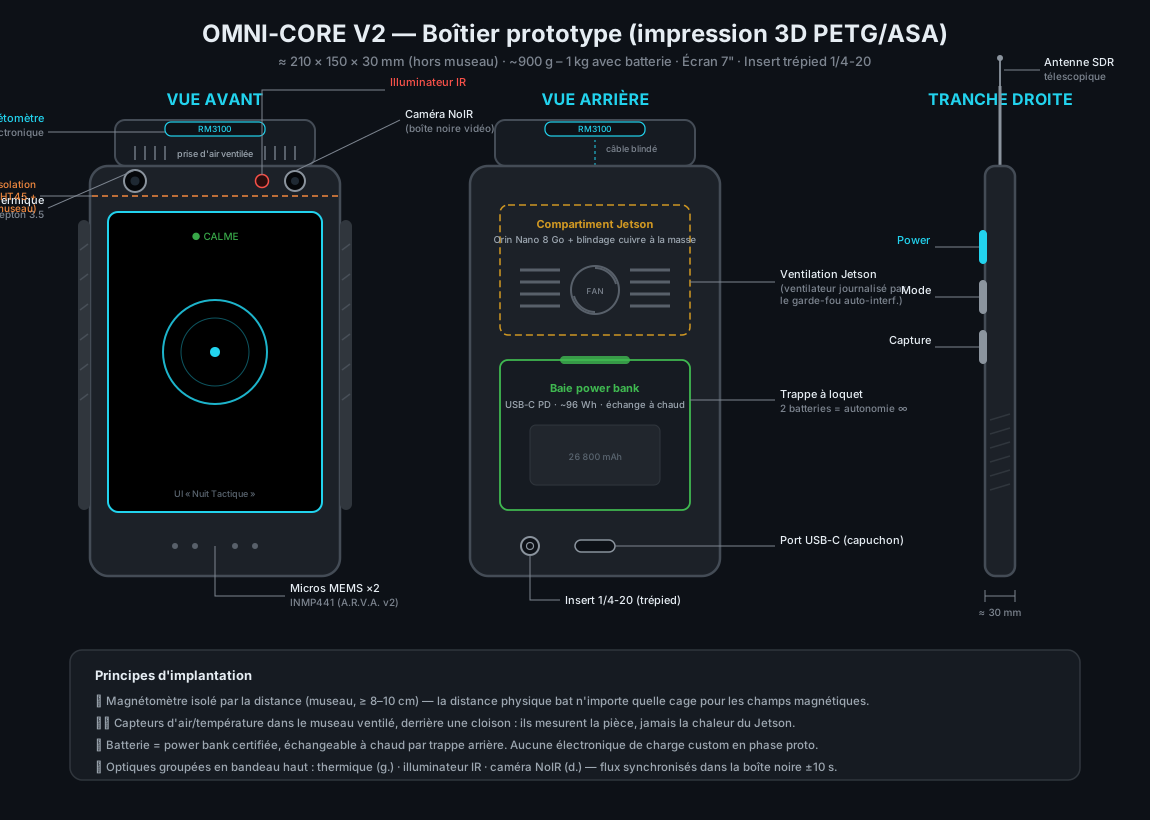
Four layout rules, all in service of the measurement:
- the magnetometer lives in a snout at the head of the device, 8–10 cm away from the electronics — distance is the best magnetic isolation;
- the air sensors sit in the ventilated snout, behind a thermal bulkhead: they measure the room, never the processor’s heat;
- the active zone is shielded with grounded copper tape, and its ventilation is logged by the self-interference guard;
- the sentinel’s antenna sits opposite the processor, the SSD and the HDMI cable, on the shortest possible lead: all three radiate broadband noise that would drown out the 2.4 GHz band it listens to.
Power
The development bench runs on DeWalt 20 V power-tool batteries (a 5.0 Ah pack is about 90 Wh for 585 g), through a 12 V DC/DC converter: the Jetson accepts 9–20 V, so the 12 V rail powers it directly. 15–22 W budget in mission, i.e. an estimated 3.5 to 5 h per battery, to be measured in phase 3. The bench will get two bays, joined by diodes, for hot-swapping: the second battery goes in before the first comes out — two batteries, unlimited runtime. This is a development solution: the product will also have two batteries, custom-made, on the same 12 V rail. A Silence mode (Wi-Fi off, screen off) halves consumption and minimizes self-interference for critical measurements.
The “Tactical Night” interface
Black background, off-white text, neon accents: cyan on standby, green when calm, red on alert, violet for an electrical signature in a building declared unpowered. A Hunter mode (central radar, status borders, A.R.V.A. zone) and an Expert mode (real-time curves, RF waterfall, guard view, log export).